
Unpaid Wages and Overtime in California: What to Do


By Briana Kim, Employment Attorney | The Law Office of Briana Kim, P.C.
If you suspect your California employer owes you unpaid wages or overtime, act quickly: collect your records, audit them for missing pay, and do not wait; strict deadlines apply. California wage law is among the most protective in the country, and workers can recover unpaid wages plus penalties.
Here is how to spot the problem and protect your claim.
What should I do first?
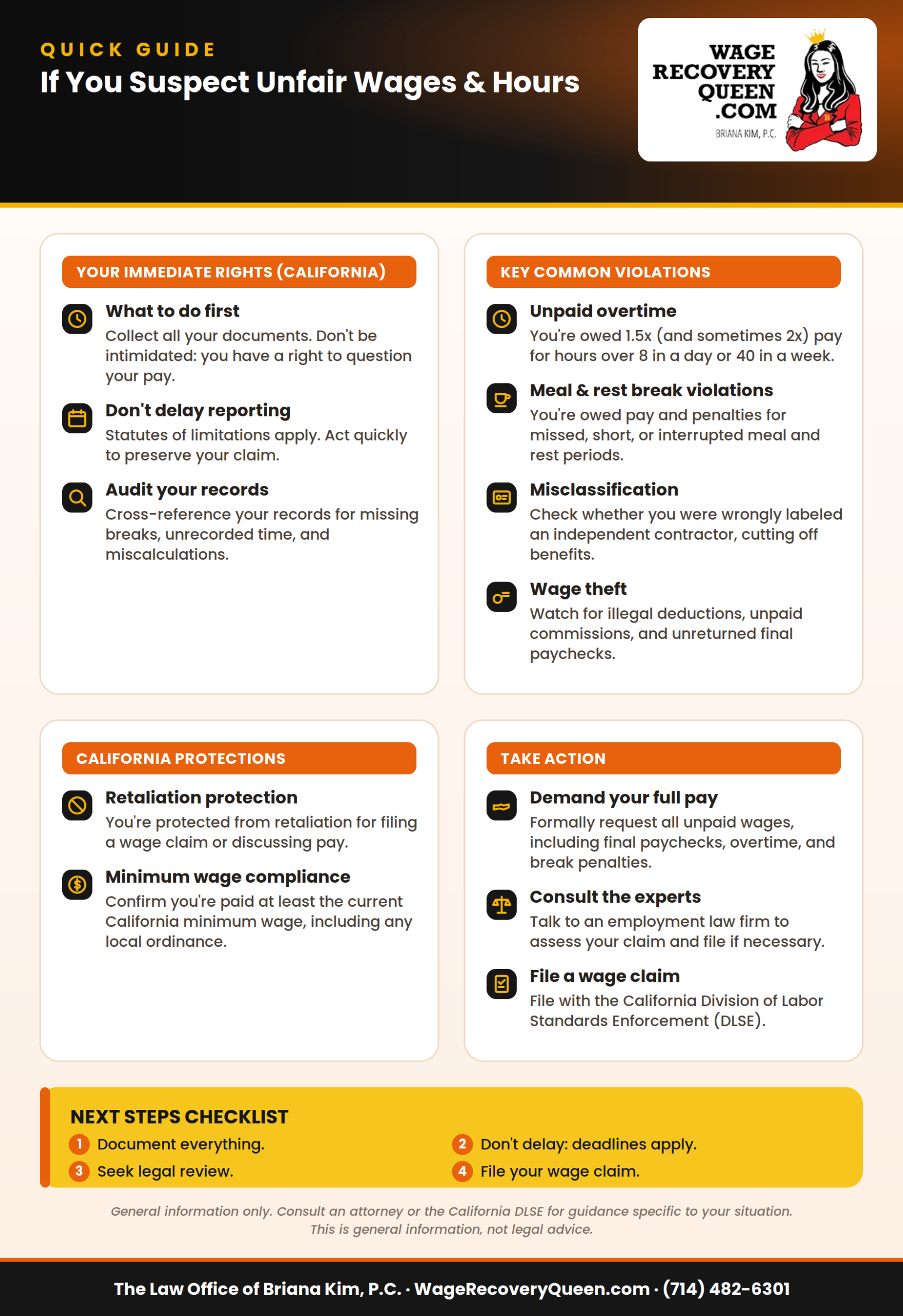
- Collect your documents. Gather pay stubs, time records, schedules, and your offer letter. You have a right to question your pay.
- Don’t delay reporting. Statutes of limitations apply, so acting quickly preserves your claim.
- Audit your records. Cross-reference everything for missing breaks, unrecorded time, and miscalculations.
What are the most common wage and hour violations?
Most California wage cases fall into four buckets:
- Unpaid overtime. Under California Labor Code Section 510, non-exempt employees are owed 1.5x pay for hours over 8 in a day or 40 in a week — and 2x for hours over 12 in a day.
- Meal and rest break violations. Miss a required break and you are generally owed one hour of pay as a premium (Labor Code Section 226.7).
- Misclassification. Being wrongly labeled an “independent contractor” or “exempt” employee can strip you of overtime and benefits.
- Wage theft. Illegal deductions, unpaid commissions, and unreturned final paychecks all count.
How do I recover unpaid wages?
Take action in this order:
- Demand your full pay. Formally request all unpaid wages – final paychecks, overtime, and break penalties.
- Consult an employment law firm to assess your claim and decide whether to file.
- File a wage claim with the California Division of Labor Standards Enforcement (DLSE), also called the Labor Commissioner’s Office.
What protects me if I speak up about my pay?
California law protects you from retaliation for filing a wage claim or discussing your pay with coworkers. You are also entitled to at least the current California minimum wage, including any higher local minimum wage ordinance that applies where you work. An employer cannot legally punish you for asserting these rights.
Frequently asked questions
How is overtime calculated in California? Non-exempt employees earn 1.5x their regular rate over 8 hours in a day or 40 in a week, and 2x over 12 hours in a day or beyond 8 hours on the seventh consecutive workday.
What can I recover in a wage claim? Depending on the facts, you may recover unpaid wages, overtime, meal and rest break premiums, interest, and penalties such as waiting-time penalties for late final pay.
How long do I have to file a wage claim in California? Deadlines vary by claim type, and some are as short as one year, so it is best to act quickly and get advice early.
Talk to the Wage Recovery Queen™
If you think you have been shorted on pay, get a free, confidential review of your wage claim. Call (714) 482-6301 or request your free consultation. Our wage & hour attorneys fight for employees across Long Beach, La Palma, and Southern California.
This is general information, not legal advice. Consult an attorney or the California DLSE for guidance specific to your situation.
Briana kim, pc focuses on employment law

Get A Free Consultation
Fields Marked With An “ * ” Are Required
locations
249 East Ocean Blvd, Ste 814
Long Beach, CA 90802
6 Centerpointe Dr, Ste 700,
La Palma, CA 90623

Contact
© 2026 Copyright The Law Office of Briana Kim. All Rights Reserved.
*Images are obtained under license from Canva and other third-party stock image providers, with attribution included where required.
Digital Marketing By 