
FMLA Leave in California: What Employees Need to Know


By Briana Kim, Employment Attorney | The Law Office of Briana Kim, P.C.
The federal Family and Medical Leave Act (FMLA) lets eligible employees take up to 12 weeks of job-protected, unpaid leave for a serious health condition, a family member’s care, or a new child. In California, the Family Rights Act (CFRA) adds its own protections on top. If your leave was denied, or you were punished for taking it, you may have a claim and should contact a local FMLA attorney.
Here is how FMLA leave works and how to protect it.
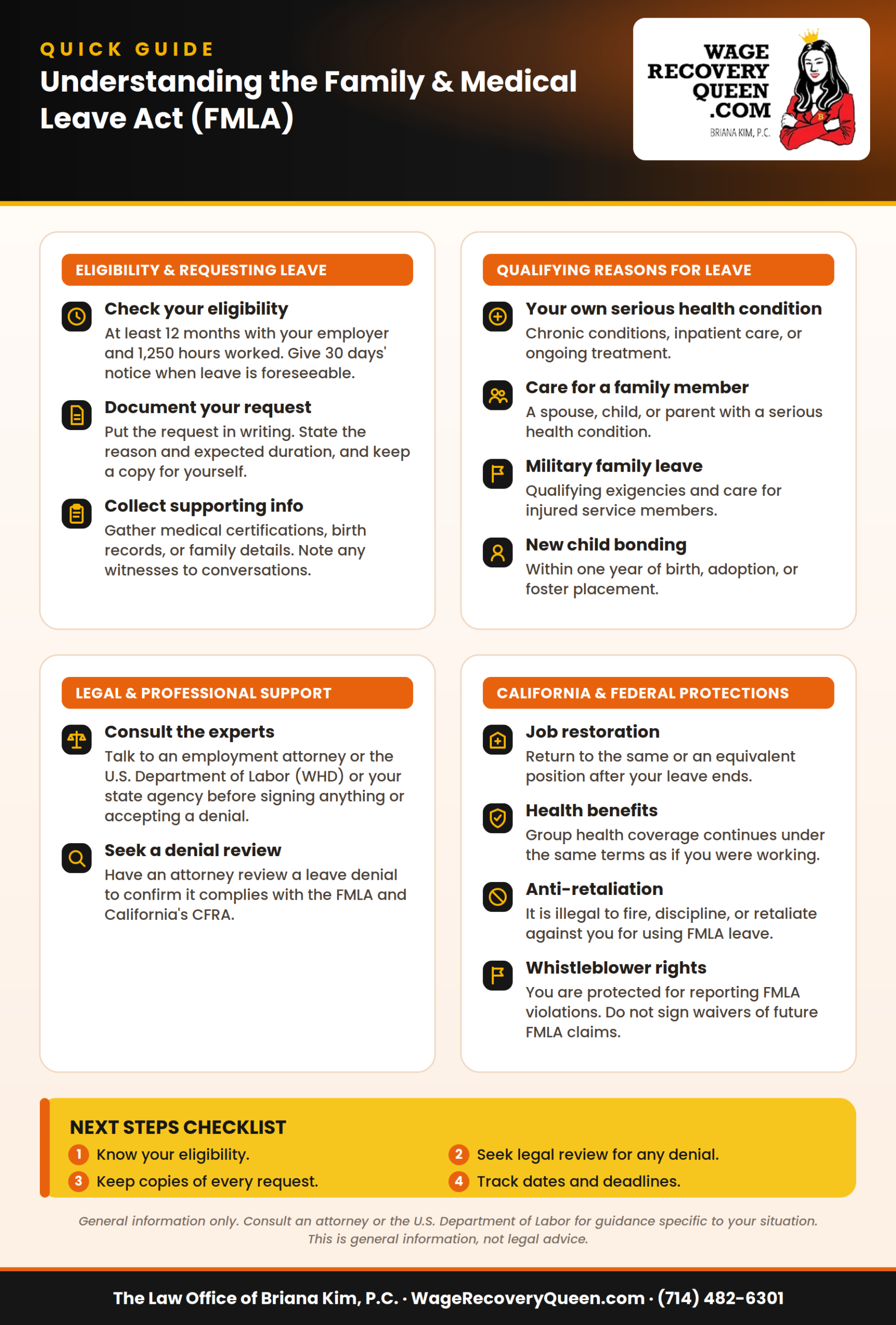
Am I eligible for FMLA leave?
You are generally eligible if you have worked for a covered employer for at least 12 months and 1,250 hours in the prior year. When your leave is foreseeable, give at least 30 days’ notice.
To request it the right way:
- Put your request in writing. State the reason and the expected duration, and keep a copy.
- Collect supporting information. Gather medical certifications, birth records, or family details, and note any witnesses to conversations with HR.
What reasons qualify for FMLA leave?
FMLA leave covers four main situations:
- Your own serious health condition — chronic conditions, inpatient care, or ongoing treatment
- Care for a family member — a spouse, child, or parent with a serious health condition
- Military family leave — qualifying exigencies and care for injured service members
- New child bonding — within one year of birth, adoption, or foster placement
What are my rights during and after leave?
California and federal law protect you in four key ways:
- Job restoration — return to the same or an equivalent position when your leave ends
- Health benefits — group health coverage continues under the same terms as if you were working
- Anti-retaliation — it is illegal to fire, discipline, or retaliate against you for using leave
- Whistleblower protection — you are protected for reporting FMLA violations
Do not sign a waiver of future FMLA claims without having it reviewed. In California, CFRA (Government Code Section 12945.2) can extend protections beyond the federal FMLA. For example, to more employers and family members.
What if my leave was denied or I was fired for taking it?
Have an attorney review the denial. A denial has to line up with the actual rules under the FMLA and California’s CFRA — and firing or demoting someone for using protected leave is a classic retaliation claim.
Frequently asked questions
How much FMLA leave am I entitled to? Eligible employees generally get up to 12 workweeks of unpaid, job-protected leave in a 12-month period.
Can I be fired while on FMLA leave in California? Not for taking the leave. You can only be affected by actions that would have happened anyway (like a company-wide layoff), never as punishment for using leave.
Does California give more leave than federal FMLA? Often, yes. California’s CFRA can apply to more employers and cover more family members, and it can run alongside FMLA.
Talk to the Wage Recovery Queen™
If your leave was denied or you were punished for taking it, get a free, confidential case review. Call (714) 482-6301 or request your free consultation. We help employees across Long Beach, La Palma, and Southern California.
This is general information, not legal advice. Consult an attorney or the U.S. Department of Labor for guidance specific to your situation.
Briana kim, pc focuses on employment law

Get A Free Consultation
Fields Marked With An “ * ” Are Required
locations
249 East Ocean Blvd, Ste 814
Long Beach, CA 90802
6 Centerpointe Dr, Ste 700,
La Palma, CA 90623

Contact
© 2026 Copyright The Law Office of Briana Kim. All Rights Reserved.
*Images are obtained under license from Canva and other third-party stock image providers, with attribution included where required.
Digital Marketing By 